Triangle of Sadness contains some flashes of the incisive, caustic insight of his Force Majeure and Palme d’Or-winning art-world satire The Square.
But this rather obvious take on the excesses of capitalism, depicted as a luxury yacht headed inexorably for farcical disaster, lacks the ironic cool that made those two films memorable.
Triangle Of Sadness brings little that is substantially new to warrant the elegantly shot, over-inflated production.
Nevertheless, brisk ensemble acting, enjoyable moments–both sophisticated and crowd-pleasing–and Östlund’s auteur status will steer this one safely to commercial and festival berths.
Narrative Structure
Told in three parts, with chapter headings, the film tilts at the world of privilege, and at the tradeable, shallow values that act as an entree to this milieu.
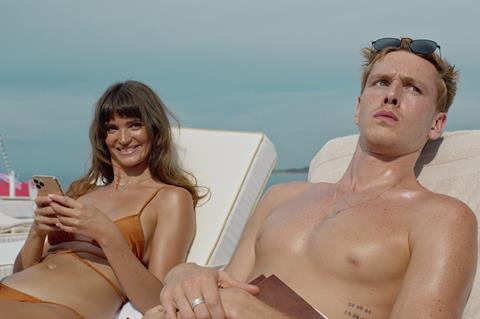
In the opening section, a fashion host interviews a crowd of bare-chested young male models. One of them is Carl (Harris Dickinson), apparently seen as past his prime three years after a prestige ad campaign.
He’s then shown with his girlfriend, fellow model Yaya (Charlbi Dean) at a posh restaurant. Their meal devolves into circular argument about her casual willingness to let him pay for the meal, even though she’s the higher earner.
The couple’s privilege is further explored in the film’s second section, set on a luxury yacht cruise – which they’ve been given for free, as Yaya is a successful influencer; she Instagrams herself ecstatically posing with the kind of food that she would never actually eat.
The cruise is an opportunity for Östlund to take jabs at capitalism and its malaises. The white-clad hospitality crew get a pep talk about pleasing the customers and getting juicy tips; “Money! Money!”, they all chant, before Östlund cuts to the below-decks crew of cleaners down below.
Among the passengers is an older Russian woman who bullies the crew into indulging her belief that “everyone is equal,” while a couple of charming elderly Brits turn out to be arms dealers (“Our best-selling product is a hand grenade”).
Things come undone on a stormy night, ill chosen for the official Captain’s Dinner – especially as the Marxist skipper (Woody Harrelson) is an out-of-control drunk who, uninterested in controlling the situation, would rather sit around trading political ideas with an equally boozy Eastern European fertilizer magnate (Zlatko Buric).
What ensues is sort of an apocalyptic toilet farce; the gross-out factor not quite as funny as Östlund intended, though it reminds that no amount of wealth will help when it comes to rolling around on slippery toilet floor.
The final chapter sees some of the characters struggling to survive when washed up on an island shore; it’s here that the film makes its most incisive satiric point, especially about social class and stratification.
The shipboard hierarchy is reversed, as toilet cleaner Abigail (Filipino actor Dolly de Leon) emerges as the only person equipped to take decisive action. That leads to her running the show as captain of this washed-up crew and exploiting her power over a fellow castaway who is at first abashed by the situation, then learns how to enjoy it.
A last-minute twist makes for a very black payoff, but it’s not quite enough to put the seal of originality on a familiar castaway scenario.
It’s a set-up that has ample potential for re-exploration, but it’s the deliberateness and over-emphasis of its treatment that makes Triangle fall short.
There’s plenty to enjoy, though – whether it’s the absurdity of Harrelson and Buric dueling with political quotations (Marx for one, Ronald Reagan for the other), the close-ups of absurdly precious dinner dishes quivering on their plates, or sight gags such as Harrelson standing at an oblique angle as the ship tilts to one side.
The acting is good, notably Dickinson as an intelligent but directionless guy doomed to eternal pretty-boy status; De Leon, playing it canny and ruthless as Abigail takes the helm; and Buric as the blustering self-described ‘shit seller’.
Fredrik Wenzel’s cinematography elegantly plays up the contrast between the classes, the gorgeous versus the abject.
Credits:
Production companies: Plattform Produktion
Producers: Erik Hemmendorff, Philippe Bober
Cinematography: Fredrik Wenzel
Editors: Ruben Östlund, Mikel Cee Karlsson
Production design: Josefin Asberg
Main cast: Harris Dickinson, Charlbi Dean, Dolly de Leon, Woody Harrelson