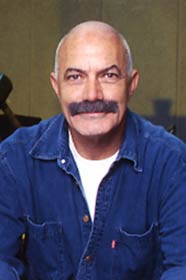
Gal Rosenbluth and Nayef Hammoud’s dramedy Non Issue, about a mixed couple who emigrate to Berlin, won the Paramount+ Award for best series pitch at the MIA television market: “We keep having to rewrite it every time something new and terrible happens.”

Gal Rosenbluth and Nayef Hammoud share the couch in their Tel Aviv apartment, sitting in front of a computer for our video call. Off camera, curled up at their feet, is their dog. He’s an Israeli dog, they note. It’s not a minor point. The couple spent days arguing over which language — Arabic or Hebrew — they’d use to train him. In the end, Rosenbluth won out.
Rosenbluth, a film editor, was born in the US to Israeli parents and grew up in Tel Aviv. Hammoud, a screenwriter, is Palestinian, born in the Israeli city of Haifa. They met in film school and have been together for the past 8 years, sharing their lives and careers. Together, they co-wrote the dramedy series Non Issue, which won the Paramount+ Award at this year’s MIA television market in Rome.
But Hamas Oct. 7 terrorist attack on Israel and the resulting war forced them to cancel their plans to attend.
“The couple think by moving abroad they’ll be able to live like a normal couple, without carrying the weight of history on their shoulders,” says Drol. “Like all expats around the world, they end up hanging out with their native communities —Israeli and Palestinian — and the conflict returns to pollute their relationship.”
Ohad Ashkenazi of United Studios Israel, who is producing the series, came to MIA to meet with investors and broadcasters to secure the final financing to make the show. Half the budget is already in place through Israeli sources and a pilot has been shot. The Hamas-Israel war has not changed their development plans.
“Nayef and Gal don’t want to become the faces of a conflict, to become a symbol of their people or this war,” says Ashkenazi. “They want to be accepted for who they are.”
Will the war become part of the story?
Rosenbluth: We are talking about it. It will be hard to avoid it. But it is something that is happening here and now. We are going through very hard and very painful times. It’s hard to say how and if it will be part of our story because we don’t have any distance to understand it yet. What I can say is that the reality of this country, which is very harsh, is one of the reasons why our characters migrate. I mean, we don’t need the events of the last two weeks to tell the story of the conflict: Something happens here every day.
Hammoud: We have had to face so many obstacles already. The very idea of telling the story of a mixed couple, and doing it for Israeli TV, was a significant obstacle to overcome. We have been working on this story for six years. In the arc of the eight episodes, a dramatic event happens that affects the country. Well, every year we have to rewrite it because something new and terrible happens all the time. It’s normal. It’s a part of our everyday life.
Combining drama with comedy
Hammoud: Our mantra as artists is this: If there is too much darkness, add comedy. If the tone is too funny, put in some drama. I would say it reflects our attitude in life, in general. The best comedy is born out of pain. We try to be extremely serious and responsible when we talk about politics, about relationships between people, societies and nations. But at the same time we would like to entertain and engage everyone. Not only Israelis and Palestinians. Ours is a story of love, life and immigration.
How did you both meet?
Rosenbluth: We have similar backgrounds. We both grew up in big cities, from secular families, open-mindedness with democratic values. We met in film school, not in a parade or a demonstration.
Other couples like you?
Rosenbluth: A few. None have stayed [in Israel].
Thought of leaving?
Work together as a couple?
Rosenbluth: We write half and half. I take the Israelis’ parts, Nayef the Palestinians. That way, both perspectives come into the story. Whenever we argue, we use each other’s arguments and put them into the script.
Discussing political issues?
Rosenbluth: You have to have an open mind. When you have these kinds of relationships, you have to be ready to subvert the narrative you grew up with. I no longer believe the ideas I had as a child. Of course, you have to be of a certain inclination, maybe be a bit self-destructive [and enjoy] complicated situations. Otherwise, the relationship would not survive. Sometimes I tell myself: Shoot, I could have married a rich Jew who works in high-tech with a lot of houses in Tel Aviv. Life would have been easier.
Hammoud: The relationship requires commitment. Sometimes a trip to IKEA is enough to trigger a negotiation issue between territories. Adopting the dog was hell. We had terrible fights to decide what language we should use to speak to our dog.
Rosenbluth: All I can say is that we are filled with sorrow for what is happening, for anyone who lives in this region: anxiety and fear. We all live in this state. It is even difficult to describe it.
Hammoud: But we are not political and we don’t want to talk about politics. It is very complicated for us. We are not speaking as Palestinian and Israeli but as ordinary citizens, individuals, as people who have friends and loved ones who are suffering. We try to look at the situation from above, but it is impossible. As Gal says: We are constantly dealing with complicated situations.
happy ending?
Rosenbluth: I don’t know about happy. Let’s say, bittersweet?