20th Century Women: Screenplay (Mike Mills)

20th Century Women

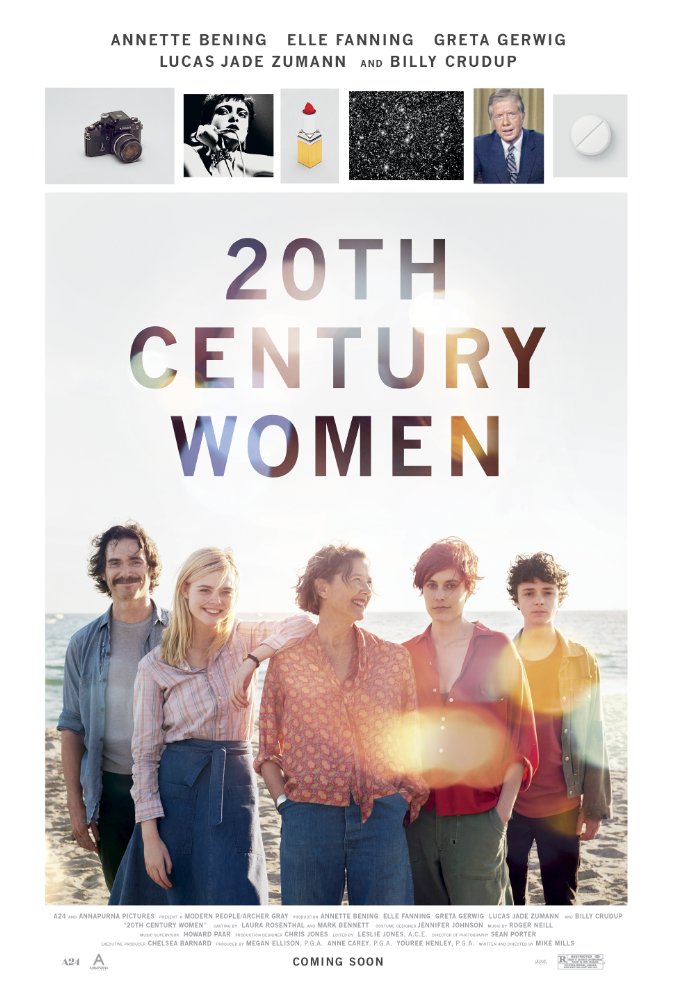
The story centers on a freethinking Santa Barbara mother (played by Annette Bening), who enlists the help of two young women (Elle Fanning, Greta Gerwig) while bidding to raise her adolescent boy properly during a period of cultural and social turmoil.
Writer-director Mike Mills has always plundered his own past in order to provide the foundations for a perceptive study of a family at work. In his last film, Beginners, he remembered his father.
This time around, he recalls the tender relationship he enjoyed with his mother, using this template to explore the way in which three females — provocative ingénue Julie (Fanning), twentysomething punk Abbie (Greta Gerwig) and laidback mum Dorothea (Annette Bening) — raise a single adolescent male (Lucas Jade Zumann).
The young teenager Jamie (who stands in for Mills) is, much like America in 1979, is at a crossroads. We see his family and friends gathered around the TV watching Jimmy Carter’s crisis of confidence speech that ushers in the end of an era; Reagan is soon elected to the White House. Will Jamie also now live under a stricter regime? Certainly, the three women in his life all wonder if he might require more structure.

Is it really necessary to have a male in the house in order to raise a boy into proper manhood, the mother asks?

Apparently not.

Realizing there’s no man in his life with whom Jamie can connect — Billy Crudup’s household handyman is way too earthy — his mum asks his girlfriend (two words — not ‘girlfriend’) and the household’s female lodger to help monitor her son’s maturation.

Jamie’s in love with Jullie, who’s several years older than him but seems light years ahead — a child of group therapy, she yearns to be a woman. She teaches Jamie how to act cool around girls and explains why she sleeps around, even though she not always enjoys it.

For her, sex and love are not always obvious bedfellows. Then there’s Abbie, a punk-loving photographer who’s getting to grips with the repercussions of cervical cancer. She is deep and dark and swimming in raw emotions. Through her, Jamie learns how to chat up, and pleasure, women. He also learns about punk.

The story echoes the feeling of memory, and for all the tumult and confusion besetting the protagonists, the film is bathed in a golden glow.

Through Jamie, it’s a study of what makes a modern man. But we also see, via the vagaries of the women’s lives, some of the challenges that face the modern woman. Whether it is through Abbie’s response to her health issues or Dorothea’s concern over her perceived sexual and social redundancy, the film reveals much about the weaknesses and strengths, victories and defeats that accompany life’s journey.

This is Zumann’s breakout, but it’s the three women who dazzle in their vibrant and vulnerable interpretations

An insightful, bitter-sweet, occasionally funny filmmaking. Artfully shot and structured, while its warmth and wit shine as brightly as the Californian sun.

The film was nominated for the Best Original Screenplay Oscar.

Share this:
Share this page via Email Share this page via Stumble Upon Share this page via Digg this Share this page via Facebook Share this page via Twitter