Research in Progress (April 25, 2023)
Exercise in Cineliteracy: What You Need to Know about the Movie Year of 1932
OSCAR YEAR: 1931-1932
WINNERS
Best Picture: Grand Hotel (MGM, produced by Irving Thalberg)
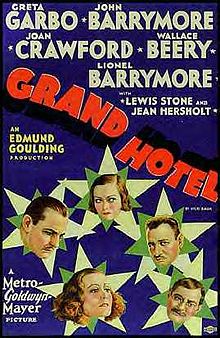
Our Review of Grand Hotel
Oscar: Grand Hotel (1932): Best Picture Starring Garbo, Barrymore, Crawford
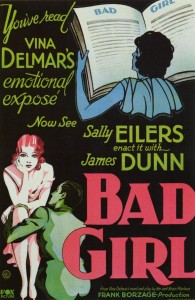
Director: Frank Borzage, Bad Girl (Fox)
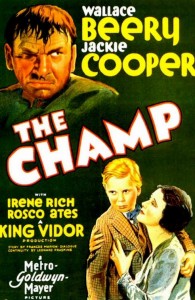
Actor: Wallace Beery, The Champ
Actress: Helen Hayes, The Sin of Madelon Claudet
Writing Adapted: Bad Girl, Edwin Burke
Original Story: The Champ, Frances Marion
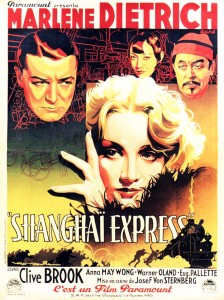
Cinematography: Shanghai Express, Lee Garmes
Interior Decoration: Transatlantic, Gordon Wiles
Sound Recording: Paramount Studio Sound Department
SHORTS
Short Subjects Cartoons: Flowers and Trees (Disney)
Short Subjects Comedy: The Music Box (Hal Roach), Laurel and Hardy
Short Subjects: Novelty: Wrestling Swordfish, Mack Sennett, Educational (Cannibals of the Deep)
Special Award:
Walt Disney, for the creation of Mickey Mouse (Statuette)
Best Picture: Nominees
Grand Hotel (MGM)
Arrowsmith (Goldwyn)
The Champ (MGM)
Five Star Final (First National)
One Hour With You (Paramount)
Shanghai Express (Paramount)
Smiling Lieutenant (Paramount)
Director:
Frank Borzage, Bad Girl
King Vidor, The Champ
Josef von Sternberg, Shanghai Express
Best Actor: Tie
Wallace Beery, The Champ
Alfred Lunt (The Guardsman)
Fredric March, Dr. Jekyll and Mr. Hyde
Best Actress:
Helen Hayes, The Sin of Madelon Claudet
Lynne Fontanne, The Guardsman
Marle Dressler, Emma
WRITING
Adaptation:
Bad Girl, Edwin Burke
Arrowsmith, Sidney Howard
Shanghai Express, Lee Garmes
Original Story:
The Champ, Frances Marion
Lady and Gent, Grover Jones and William Slaven McNutt
Star Witness, Lucien Hubbard
What Price Hollywood Adela Rogers St. John
Cinematography:
Shanghai Express, Lee Garmes
Arrowsmith, Ray June
Dr. Jekyll and Mr. Hyde, Karl Struss
Interior Decoration:
Transatlantic, Gordon Wiles
A Nous La Liberte, Lazare Meerson (French film)
Arrowsmith, Richard Day
Sound Recording:
Paramount Studio Sound Department
Short Subjects Cartoons:
Flowers and Trees (Disney)
Short Subjects Comedy:
The Music Box (Hal Roach), Laurel and Hardy
Short Subjects: Novelty:
Wrestling Swordfish, Mack Sennett, Educational (Cannibals of the Deep)
Special Award:
Walt Disney, for the creation of Mickey Mouse (Statuette)
Oscar Context
Of the 8 films nominated for Best Picture, half (4), including the winner, “Grand Hotel,” received only one nomination. Three of the Best Picture nominees were produced at Paramount, and two at MGM.
Only three performances were nominated for Best Actor and Best Actress. The ensemble-driven “Grand Hotel,” with great performances from Garbo, John Barrymore, Joan Crawford, and others, didn’t receive any acting nomination, a trend that would continue in the future for large-cast pictures.
Top-Grossing Films
Top ten 1932 films by box office gross:
1 The Kid from Spain, United Artists/Samuel Goldwyn Productions $2,621,000
2 Grand Hotel, Metro-Goldwyn-Mayer $2,250,000
3 Emma $1,409,000
4 Dr. Jekyll and Mr. Hyde =, Paramount Pictures $1,300,000
5. Hell Divers, Metro-Goldwyn-Mayer $1,244,000
6 Prosperity $1,166,000
7 Tarzan the Ape Man, $1,112,000
8 One Hour with You, Paramount Pictures $1,100,000
9 Smilin’ Through Metro-Goldwyn-Mayer $1,004,000
10 Strange Interlude, $957,000
Other Significant Movies
Boudo Saved from Drowning, Renoir
Freaks
Love Me Tonight
Scarface, Hawks
Shanghai Express
Trouble in Paradise
Vampyr, Dreyer
Events:
July 1932:
Disney’s short talking film Flowers and Trees (1932) was the first in the Silly Symphony series. It premiered in July of 1932 at Grauman’s Chinese Theatre in Hollywood. It was the first animation short to use 3-strip (three-color) Technicolor (as was Disney’s Three Little Pigs (1933), the first globally-successful story). It also was the first cartoon to win the first Best Short Subject Oscar – Cartoon (animation).
Venice Film Festival:
The world’s first major film festival was held in Venice, Italy – it was part of the Venice Biennale, a major contemporary art exhibition and festival that took place every two years. The international film festival presented Best Actor and Best Actress awards to Fredric March (for Dr. Jekyll and Mr. Hyde (1931)) and to Helen Hayes (for The Sin of Madelon Claudet (1931)). Rene Clair’s French film A Nous La Liberte (1931) was considered the “most amusing” of the films exhibited.
Scarface
Howard Hawks’ gangster film Scarface was targeted by the Production Code for its violence, sexual innuendo, and ending (which was re-edited). The film was also forced to be re-named Scarface: The Shame of the Nation.
Paramount Pictures, founded in 1912, curtails activities in its East Coast studios in Astoria (Long Island, NY) and moved to Hollywood, once the conversion to “talkies” was complete. Astoria had been the center of the East Coast film industry in the 1920s, and many stage actors (Jeanne Eagels, Ruth Chatterton, Fredric March, John Cromwell, Claudette Colbert, Ginger Rogers, Edward G. Robinson, Jeanette MacDonald, and others) and directors (Rouben Mamoulian, George Cukor) had gotten their start there. It was the locale of a few early Marx Brothers films.
Director Rouben Mamoulian’s musical Love Me Tonight (1932) shaped the language of movie musicals in the sound era, by smoothly integrating the songs into the plotline. It featured the first zoom shot (into a window), the first asynchronous sound, slow-motion, fast-motion, and split-screens.
Katharine Hepburn’s Debut
Director George Cukor’s A Bill of Divorcement (1932) marked the film debut of Katharine Hepburn, age 24, as Sydney Fairfield (misspelled as Sidney and Katherine in the credits). The master filmmaker would team with the hard-headed actress for another 11 films.
Tarzan, the Ape Man
MGM launches the career of Olympic swimming champion Johnny Weissmuller as Tarzan, the Ape Man, one of the longest and most popular series in film history.
Shirley Temple
The film career of 4 year-old child star Shirley Temple (born in 1928), probably the most famous child actress in history, began when she appeared in eight exploitative one-reeler shorts, in a series from Educational Pictures called the ‘Baby Burlesks’. In the short take-offs, toddlers played adult roles and wore provocative clothing. Her first film appearance was in the first film of the series titled Runt Page (1932). Her feature film debut was in The Red-Haired Alibi (1932). Fox signed five-year old Shirley to a contract in 1933. She would become one of the biggest box-office stars in the mid to late 1930s (1936-1938).
First Zombie Film
Victor Halperin’s independent, low-budget horror film White Zombie (1932), was the first feature-length zombie film – the archetype and model for all subsequent zombie films. It starred Bela Lugosi as hypnotic and sinister Haitian sugar mill owner “Murder” Legendre with zombie slaves, was deliberately made with minimal dialogue, and filmed to be visually atmospheric and expressionistic.
Freaks
Tod Browning directed the gothic Freaks with real-life side-show “freaks” – one of his best works. It told how a group of freaks took revenge on a beautiful gold-digging trapeze artist and turned her into a monstrous half-human, half-bird. This cult film redefined the concepts of beauty, love, and abnormality, but was so disturbingly ahead of its time that audiences stayed away in huge numbers, and it was even banned for 30 years in England.
Jean Renoir
French director Jean Renoir directed Boudu Saved From Drowning (1932) (aka Boudu Sauvé Des Eaux), a critique of the French bourgeoisie, in its tale of an urban bum (Michel Simon) who was rescued by a bourgeois bookselling gentleman and brought to his apartment. The story served as the basis for Paul Mazursky’s Down and Out in Beverly Hills (1986) with Nick Nolte.
MGM’s Best Picture-winning film Grand Hotel was the first all-star feature, with major stars of the early 1930s, including John Barrymore, Wallace Beery, Joan Crawford, and Greta Garbo, etc.
It would later be copied in Dinner at Eight. Its ensemble cast of stars were occupants of a between-wars German hotel, all struggling with either their finances, health, or social standing in multiple storylines.
Suicide
Welsh-born English actress Millicent Lillian “Peg” Entwhistle, age 24, gained notoriety by jumping to her death from atop the Hollywood sign (built in 1923); she jumped from the giant “H.” She had been in only one movie role (a bit part), RKO’s Thirteen Women (1932). To add insult to injury: Much of her part was deleted from the poorly-reviewed film’s release after test screenings.
Popular Movie Stars:
Marie Dressler
Janet Gaynor
Joan Crawford
Charles Farrell
Greta Garbo
Norma Shearer
Wallace Beery
Clark Gable
Will Rogers
Joe E. Brown